Challenge: Designing for flow within one application across two user bases and two interfaces.
Wikipedia: Flow is the mental state of operation in which the person is fully immersed in what he or she is doing, characterized by a feeling of energized focus, full involvement, and success in the process of the activity. Proposed by psychologist Mihaly Csikszentmihalyi.
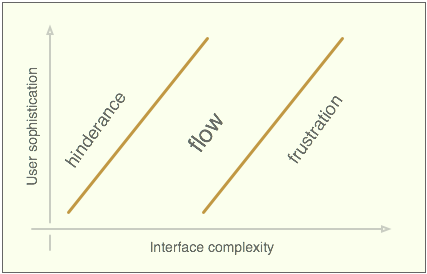
In the diagram above, users are either hindered by the UI, in flow, or frustrated when trying to complete a task.
My main users can be generalized in to two types. The mid level network admins with a moderate level of protocol and architecture knowledge. Best sumarised as needing a little 'hand holding' during setup and configuration. I've tailored the web based GUI to them. Then there are the 'cisco certified' power users who prefer the speed of the CLI. They spend more time planning their complex network designs, usualy in advance of working with the interface. The former tends to spend more time exploring the available options, the latter needs to simply get their tasks completed.
With user's needs roughly defined, designing the interfaces has clear constraining boundaries. The interface workflow must present features & options in a way that is neither too dumbed down nor too convoluted based on the user and their prefered interface. For the mid level admins, research is showing that they're happy with the gui. Predictably the power users spend their time in the CLI.
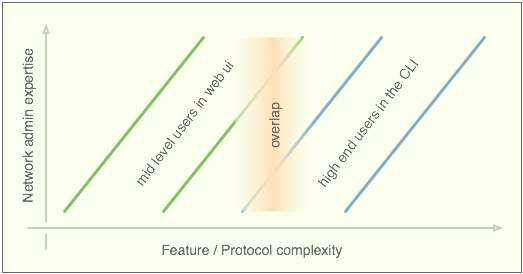
The issue is in the nature of the application, configuring networks. Some of the features transcend the upper & lower flow boundaries of a particular interface.
Going forward I need to understand the areas that are common. That is, the high end features in the low end interface and visa versa for the basic features in the CLI. Explore possibility of web-cli interface cross pollination, launching a CLI within a web ui, and pulling up a gui when appropriate for a CLI user which presents the feature in a more configurable light. As always, in progress.


